3. A Lesson in Logistics
Firstly, a recap of my first impressions of China:
1) Unbelievably clean
2) No Google Maps (big boo)
3) Visiting in August = unbearably humid
4) Visiting in August = very crowded
5) Little to no English
6) The food is very spicy (and I can’t handle my spice)
After spending my first couple of weeks in China, I could safely say that these initial impressions had largely held true. That being said, as I settled in and started exploring more, I quickly realised that I had many more observations.
But before diving into those incredibly fascinating insights, I should probably add a bit more context, namely the logistics of travelling around China, the route I took, and a thrilling (I promise!!) section on public transport. Should this have come before the last piece? Almost definitely. Is this essentially us taking a step backwards? Yes. Does it matter in the slightest? Nope. Am I going to do my best to make writing about admin and transport as engaging as possible? Hopefully.
Visas and Maps
As my close friends and family will already know (and are probably rolling their eyes just reading this), the Chinese visa process was long, tedious and required a significant amount of effort in regards to admin and paperwork. Now, people who know me well will know that I have a pretty intense fear of admin; I missed multiple school trips as a child just by forgetting to hand in forms, and once even completed a year abroad application a entire year too late. So it’s pretty hilarious that the one country I chose to visit required exactly the kind of organisation I’m worst at.
Anyway, although China has since extended visa-free stays for British/EU travellers to 30 days (it used to be around 72 hours, I think), I was staying longer so a visa was unavoidable unfortunately.
To secure a visa, I needed to have both inbound and outbound flights booked, as well as accommodation for every single night of my 46 days in China. My initial application (the first of many) was actually rejected because I left one night unaccounted for as I was planning to take an overnight train instead. So clearly someone was checking it in detail.
On top of that, I also had to visit the Chinese embassy in London twice. Once to submit everything (including my passport and a small mountain of paperwork), and again to collect it with an approved visa intact.
What this did mean was that before I had even arrived in China, I already had a very good idea of exactly where I’d be and when. Of course, the plan changed a bit here and there i.e. switching hostels or leaving places early/late (and that was strangely completely allowed!) but overall, I stuck to it surprisingly well.
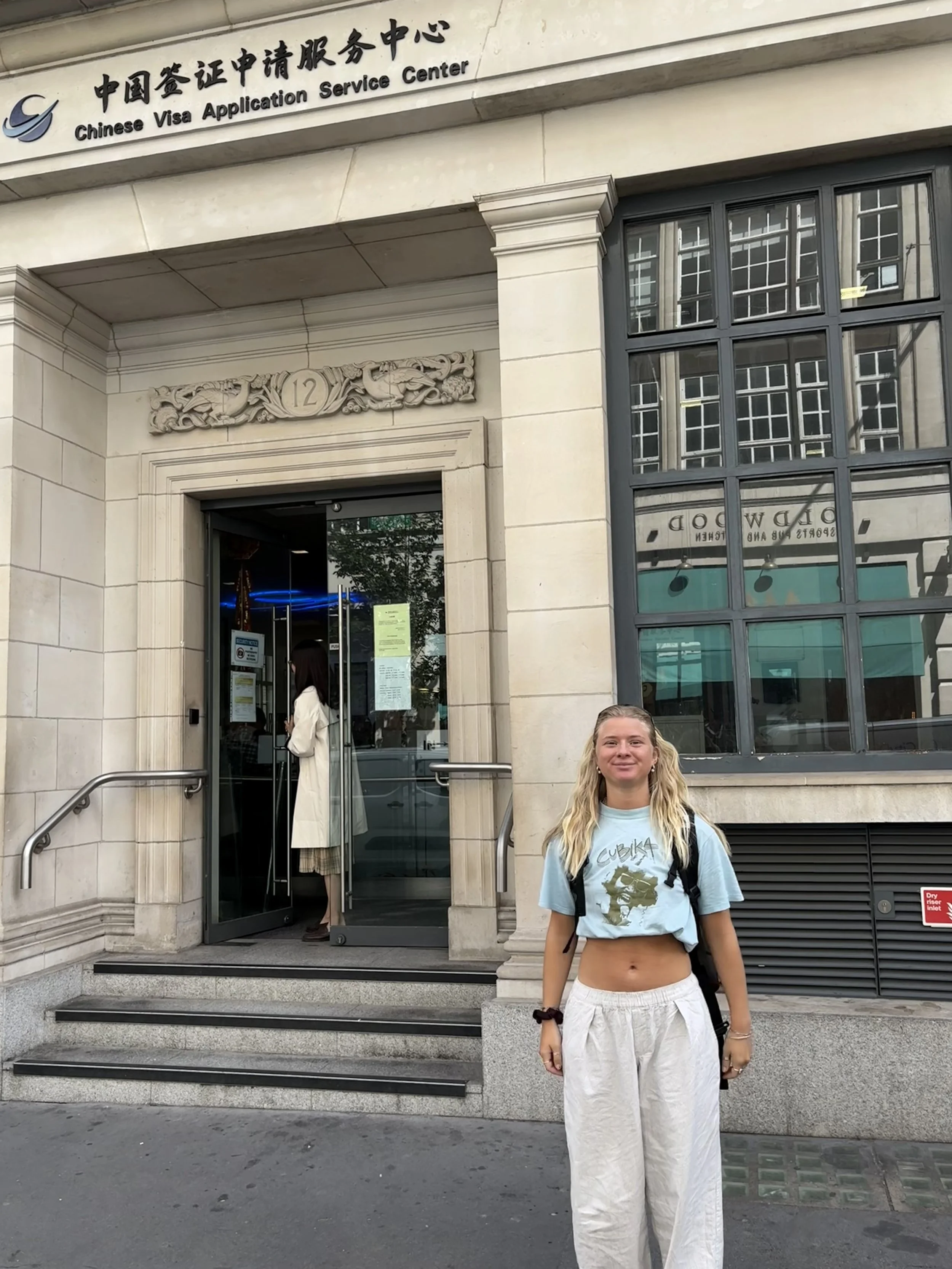
This is a very happy Holly with an approved visa!!
I also thought I’d provide some probably unnecessary geographical context. China is divided into 22 provinces. They’re kind of like UK counties, if each county were the size of an entire European country. I came across this absolutely dismal map, but it does help get my point across.
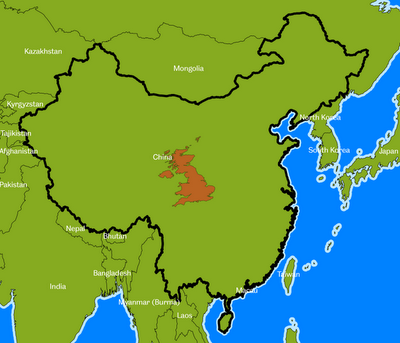
So when it came to planning, it was really about what made sense geographically. I wasn’t about to go from Guangzhou in the south to Beijing in the north one day, then back down to Shanghai the next. Even with the insane rail system they have (don’t panic, we will return to the topic of rail system later in this piece!!), it’s just too big of a country to even consider bouncing around the place.
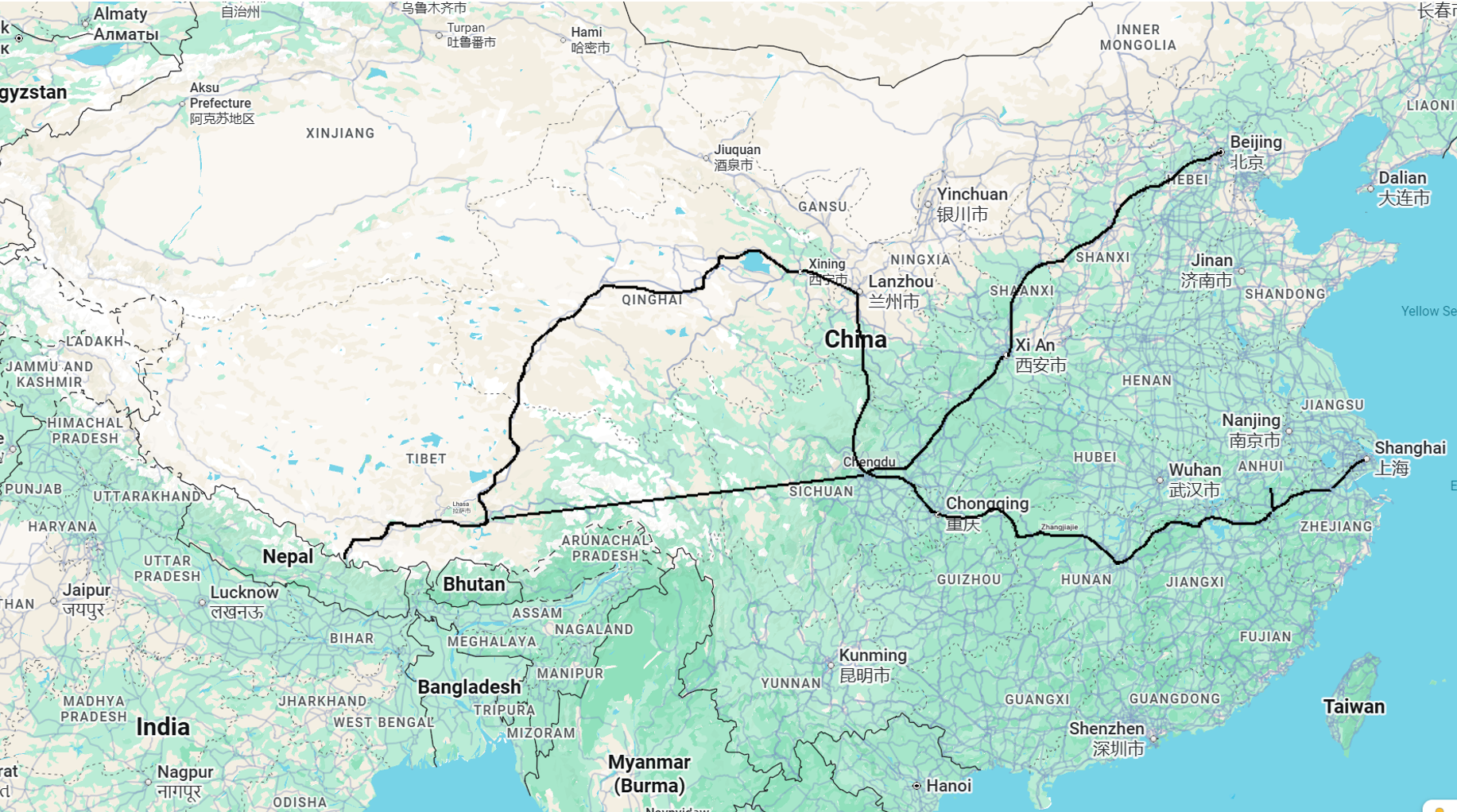
However, I didn’t fully appreciate this when I naively booked my flight out to Shanghai, followed by a 10-day trip to Tibet just three weeks later - basically one of the longest routes possible in China. That meant covering around 4,000 km in just over three weeks, which is roughly the distance from the UK to Kazakhstan. On paper, that might not sound too bad, but I’d also hoped to actually stop and explore along the way.
Nevertheless, my route ended up being a little less circular than anticipated, and more a confused figure of eight. Please appreciate this accurate, high-quality, beautifully drawn map created on Word. And yes, the very straight line is a flight, not a canon.
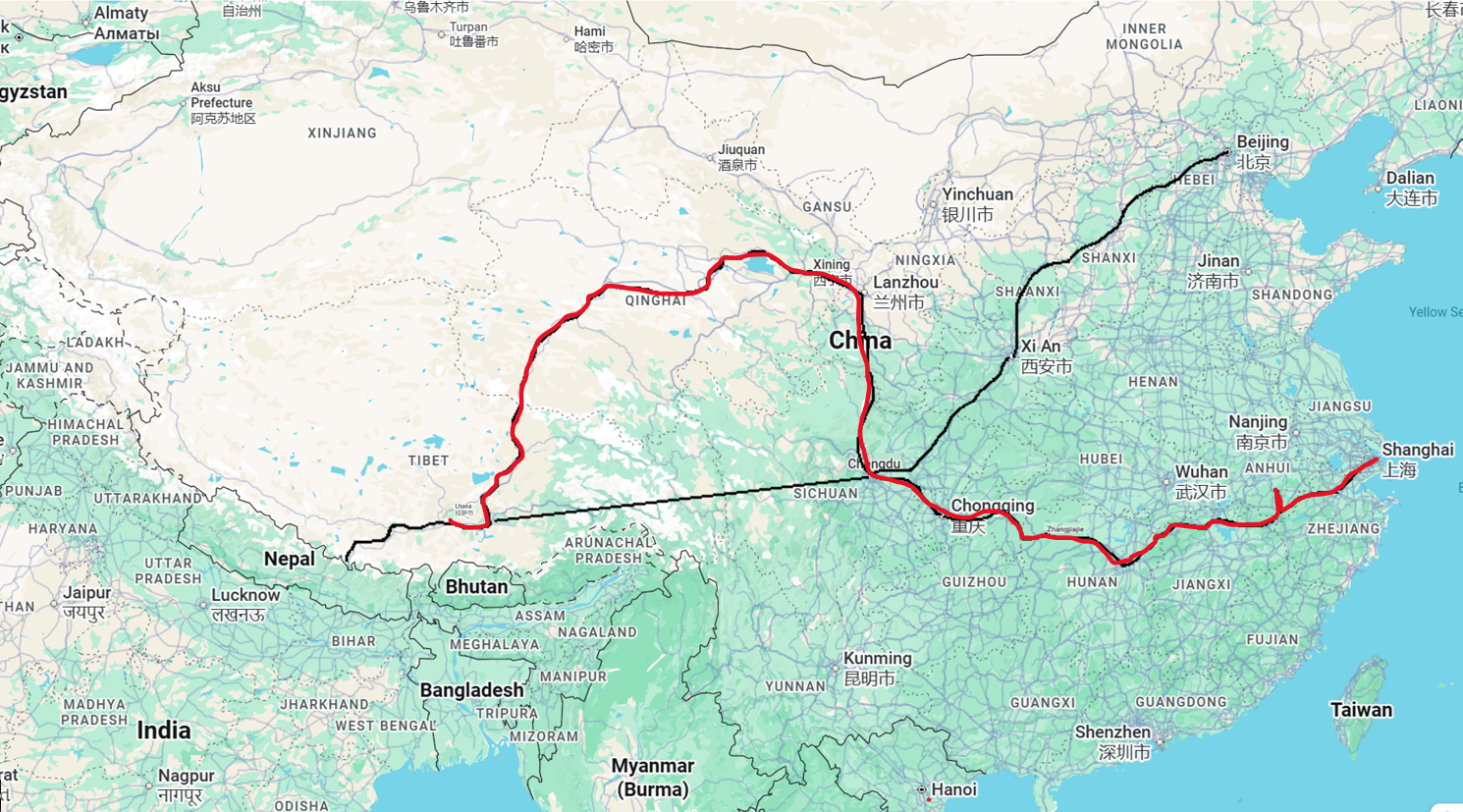
Oh and the line in red shows the first three weeks of the trip.
After researching a fair amount about where I wanted to visit, I started my journey in Shanghai and shimmied West across central-ish China for the first three weeks-ish, stopping at Hangzhou, Huangshan (or the “Yellow Mountains” in English), Zhangjiajie National Park, Fenghuang, Chongqing and ending up in Lhasa in Tibet after a fun 36-hour train. I’ll be writing a separate piece on Tibet as I have a lot to say and many compliments to give!
So, as you can see, my bad planning meant that I had to cover a huge distance in a relatively short period of time. On the bright side though, it does neatly lead me into talking about China’s incredible public transport system!
China’s Incredible Public Transport system! (if you do it right and embrace its quirks)
If I’d attempt 4,000 km on British public transport, it would probably take me 14 years and I doubt I’d make it to the end without completely losing the will to live. China on the other hand have their shit together. Their trains are quick (most high-speed trains cruise at around 300-350kmh), frequent, clean, comfortable, quiet, with 15+ carriages so there’s loads of space. There’s even enough leg room that, from a window seat, you can stand up and move past the next two people sitting beside you without so much of a brush! But, most importantly, they are always on time.
Of course, all these pros come at a cost. Firstly, I wouldn’t describe train travel in China as especially cheap - it's only slightly less expensive than in the UK. Personally though, I really don’t mind paying if I’m almost guaranteed that the service is actually running and that the journey itself isn’t making me want to die.
The other slight downside of China’s incredible railway system is the stations themselves, but even those I’d take over Manchester Piccadilly (if you know, you know). They are enormous. They make every UK airport, railway station and metro station look like those tiny request stops on the train that drop off one person, though that could be just a North Wales thing. One station I used - Chongqing East Railway station - had 29 tracks and, according to Google, spans 1.22 million square meters which is roughly 170 football fields. So you can imagine the chaos of finding the right platform when a) you’ve never been there before, b) everything’s in Chinese, and c) you’re basically walking a 10k. I did in fact miss my first ever high-speed train out of Shanghai for exactly this reason.
Also, just to further confuse things (and something I had absolutely no prior knowledge of), each major city has four main stations: north, south, east and west, usually found on the outskirts and connected by the equally incredible (but cheap!) metro system. The naming pattern of the stations are the name of the city, followed by the direction: North (北 běi), South (南 nán), East (东 dōng), West (西 xī). But you really don’t want to get it wrong. Given the sheer size of the cities, it could easily take at least an hour to get from one station to another, by which point you have almost definitely missed your train.
Another quirk - I’m going to start calling them quirks rather than cons - is that you need to book trains a few days in advance (usually at least five), as they do sell out. Luckily, I already had a route planned, so this didn’t bother me too much.
But what is interesting is you never actually get a physical ticket. Instead, your passport is your ticket (or an ID card for Chinese citizens). Every journey is linked to your passport number when you book and you simply scan it at the station to get through.
That same system reflects the wider Chinese security setup: every metro and railway station has airport-style security, with full-body scanners and X-ray checks for your luggage. Is this a pain in the arse when it’s 40 degrees and you’re carrying multiple bags? Yes. But it also makes you feel completely safe on every journey. It actually made me think it’s mental that the Tube has no security.
What’s most impressive is that, despite all this, there are no endless queues. I never once waited more than a few minutes to get through the scanners. I still don’t quite understand how, but that’s Chinese efficiency for you!
I appreciate what I’ve done here is very briefly mention the benefits of Chinese rail travel and gone into significant detail about the negatives, so it’s worth stressing here that despite what I’ve just written, the positives wayyyyy outweigh the negatives (though I haven’t mentioned the environmental impact of constructing these enormous railway systems, which, to be clear, I’m really not a big fan of but that’s a rant for another day. Maybe one day I’ll do some proper digging and poopoo the Chinese rail system).
Well that is without a doubt enough for this piece. I do hope you enjoyed and please stay tuned for more content in the future, whenever that may be!